How Reducing Onboarding Steps Improved New Agent Conversion in 30 Days
Role: Product Design Manager (design leadership and oversight for the initiative)
Ownership: Led design direction and stakeholder alignment, and supported the end-to-end delivery of the epic
Team: Junior Product Designer (epic owner) and Product Owner (day-to-day product partner), Director of Product (stakeholder), VP of Product (Stakeholder)
Timeline: Q2 2025
Problem & Context
Problem Statement
The Bold Penguin Terminal is a cloud-based commercial insurance platform that lets agents, brokers, and agencies quickly triage risks, then quote, compare, and bind small business policies from multiple carriers through a single, streamlined application interface.
New agents signing up for Bold Penguin’s Terminal often abandon onboarding before completing critical setup steps such as selecting direct or sub-appointments and entering bank account information for commissions. This leads to a surge in support requests to customer success, who must manually complete these steps on behalf of agents, delaying their time to first value—their first successful quote through Terminal—and increasing the operational burden on the CS team.
I scoped and authored the problem statement by synthesizing onboarding drop-off patterns, support signals, and partner input to clearly define the core user + business problem we needed to solve.
Opportunity Solution Tree
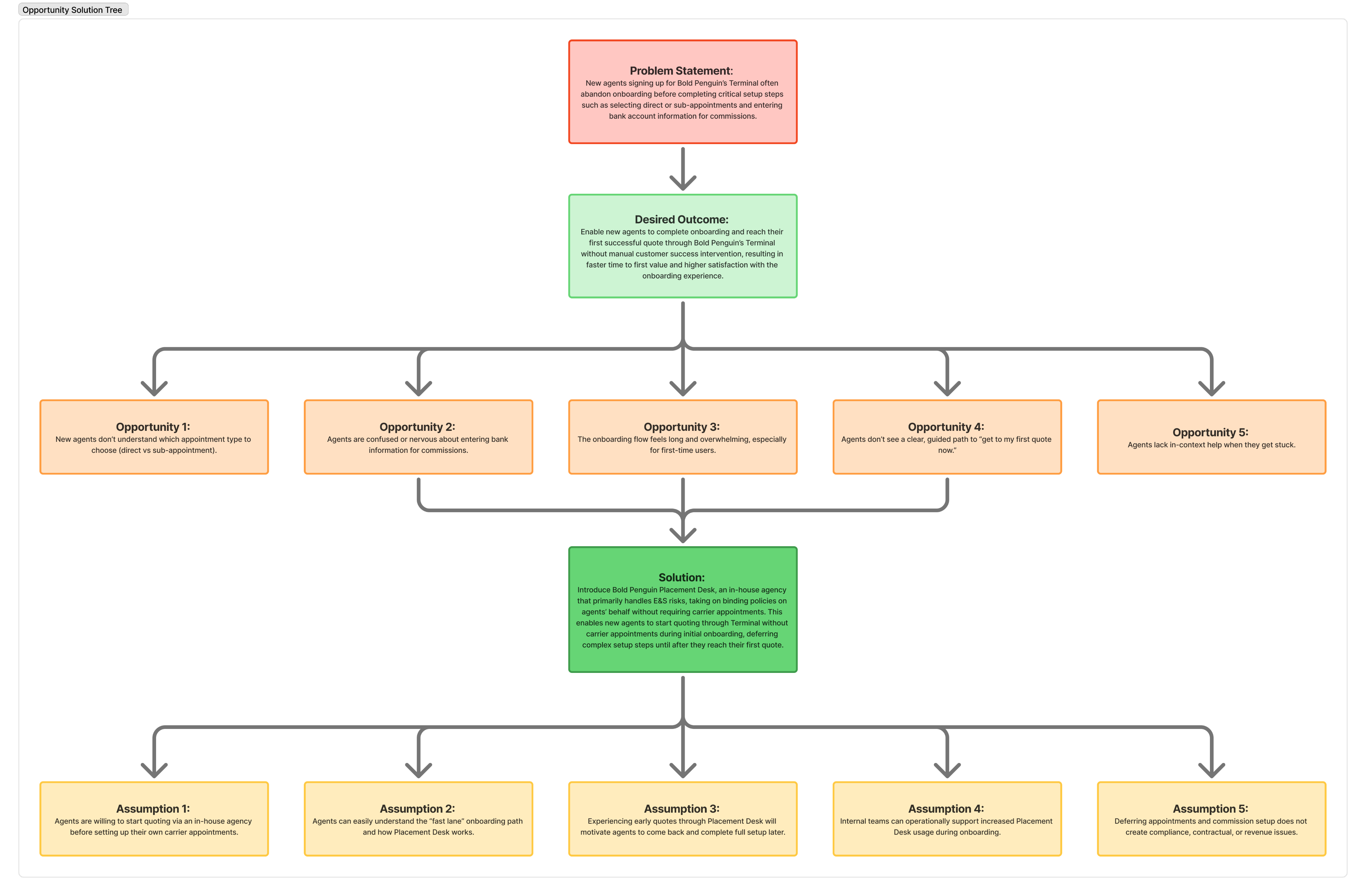
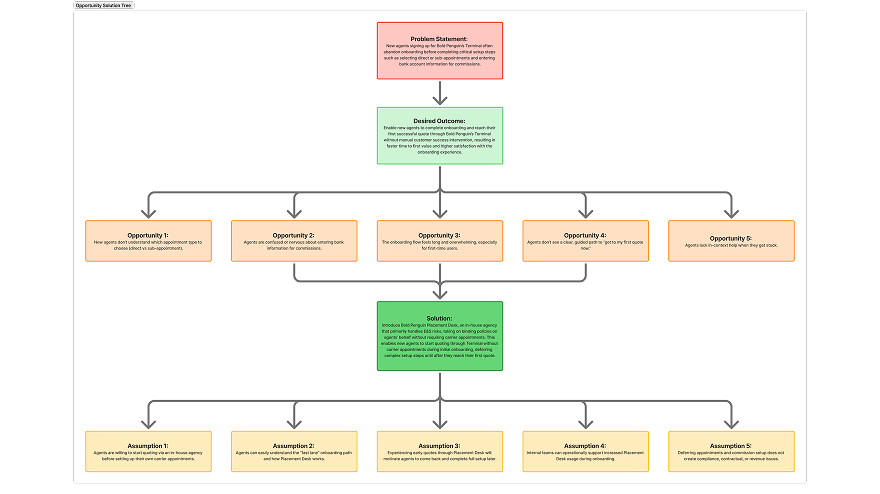
New agents signing up for Bold Penguin's Terminal frequently abandoned onboarding before completing critical steps—confused by appointment types, nervous about financial setup, and overwhelmed by a lengthy flow with no clear path to their first quote. To address this, the team introduced Placement Desk, an in-house agency that lets new agents bypass carrier appointments entirely and start quoting immediately. This "fast lane" defers complex setup until after agents experience early value, reducing friction, support load, and time to first quote.
I built the opportunity solution tree to connect the bottleneck to a clear desired outcome, opportunities, and testable assumptions the team could align on.
The Solution Chosen to Pursue
We as a team aligned as a cross-functional team to pursue Placement Desk as the primary lever to reduce early onboarding friction while preserving long-term setup needs.
Success Metrics
- Initial sign-ups (account creation + email verification) should take 60 seconds or less.
- From sign-up to first quote submission should take 5 minutes or less.
- Compliance approval for commission eligibility should take 1 hour or less from when the agent starts compliance tasks.
We defined success metrics together to measure whether the onboarding changes improved time to value and reduced operational load.
Core solution
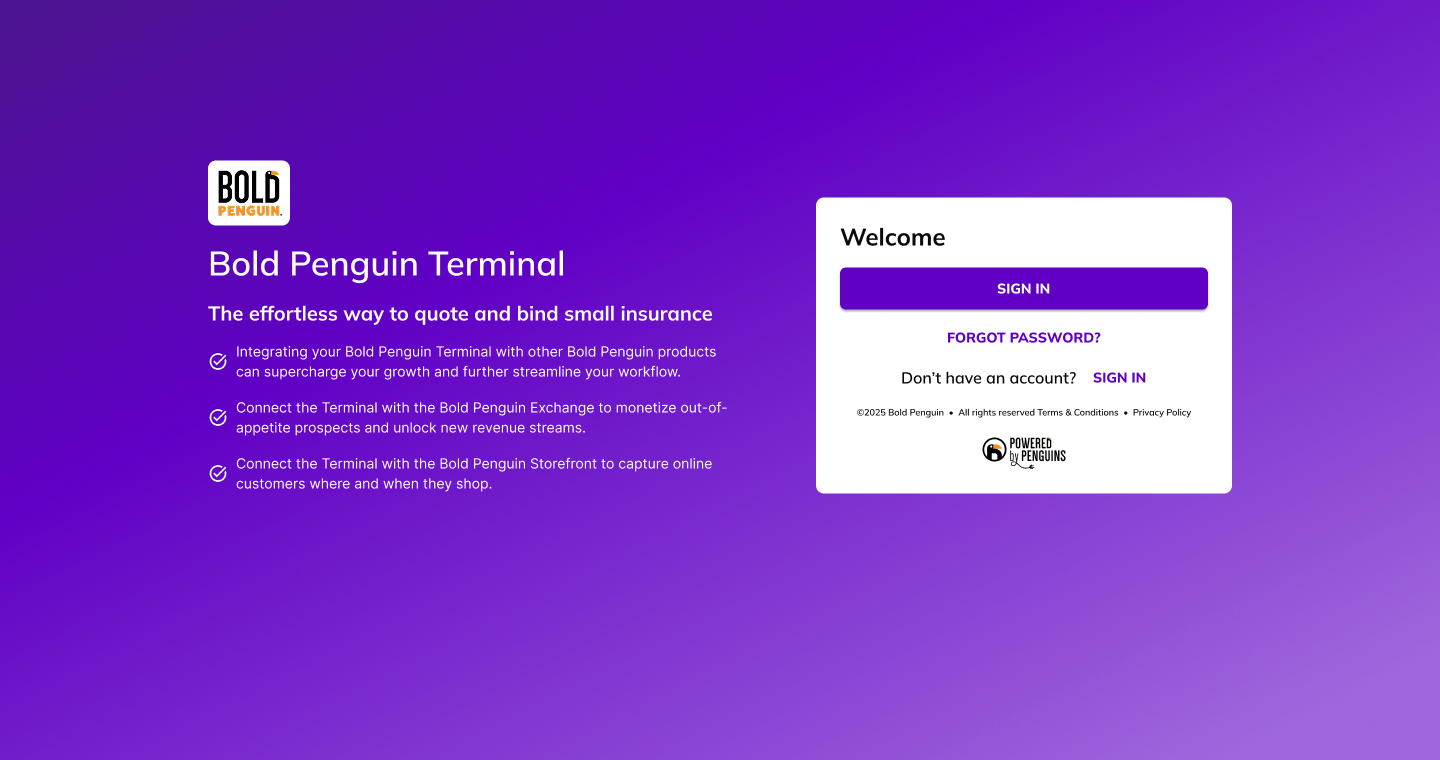
The original onboarding flow had 12 steps split into two parts: account creation and initial setup.
Before link
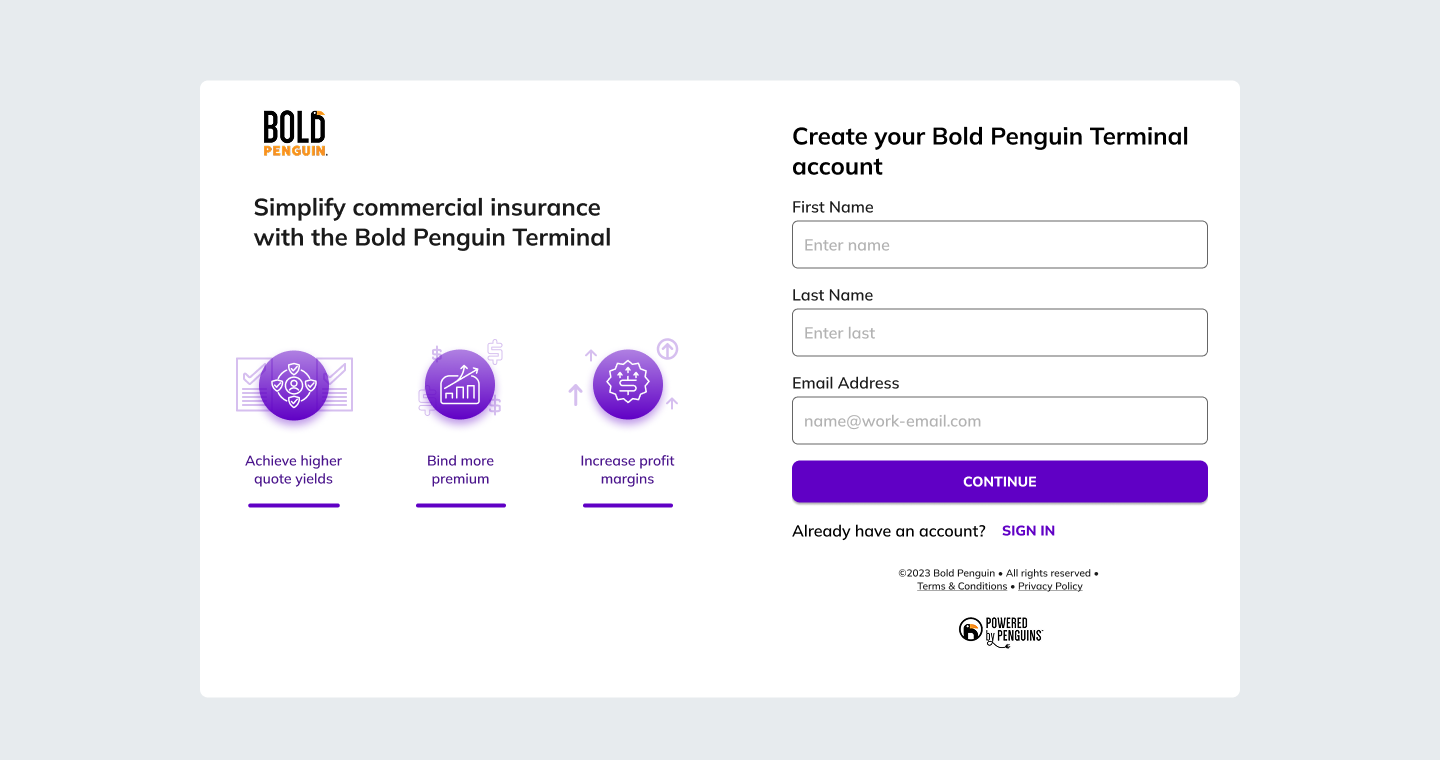
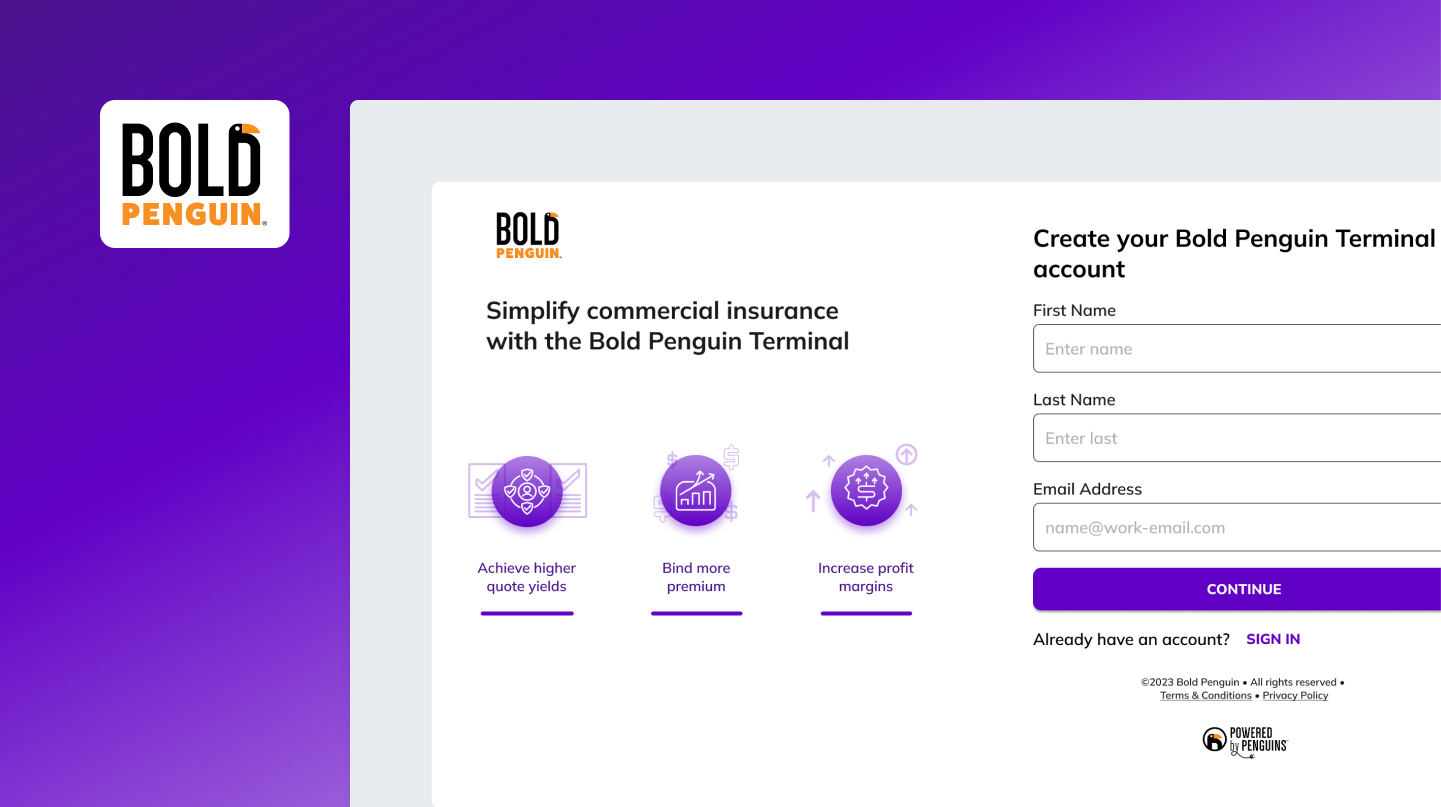
The updated onboarding flow reduces initial setup from 12 steps to 5 core steps. Once users reach the Terminal dashboard, they can choose an "adventure" path to configure Terminal at their own pace.
After link
Is it valuable to the customer?
Is it usable for the end-user?
Is it feasible to for engineering to build?
Is it viable for the business?
13% reduction in support tickets since the launch of the new onboarding within the first 90 days
In five usability sessions, test users completed sign-up on time and understood the onboarding tasks, with the main iteration need being clearer navigation to find tasks and return home.
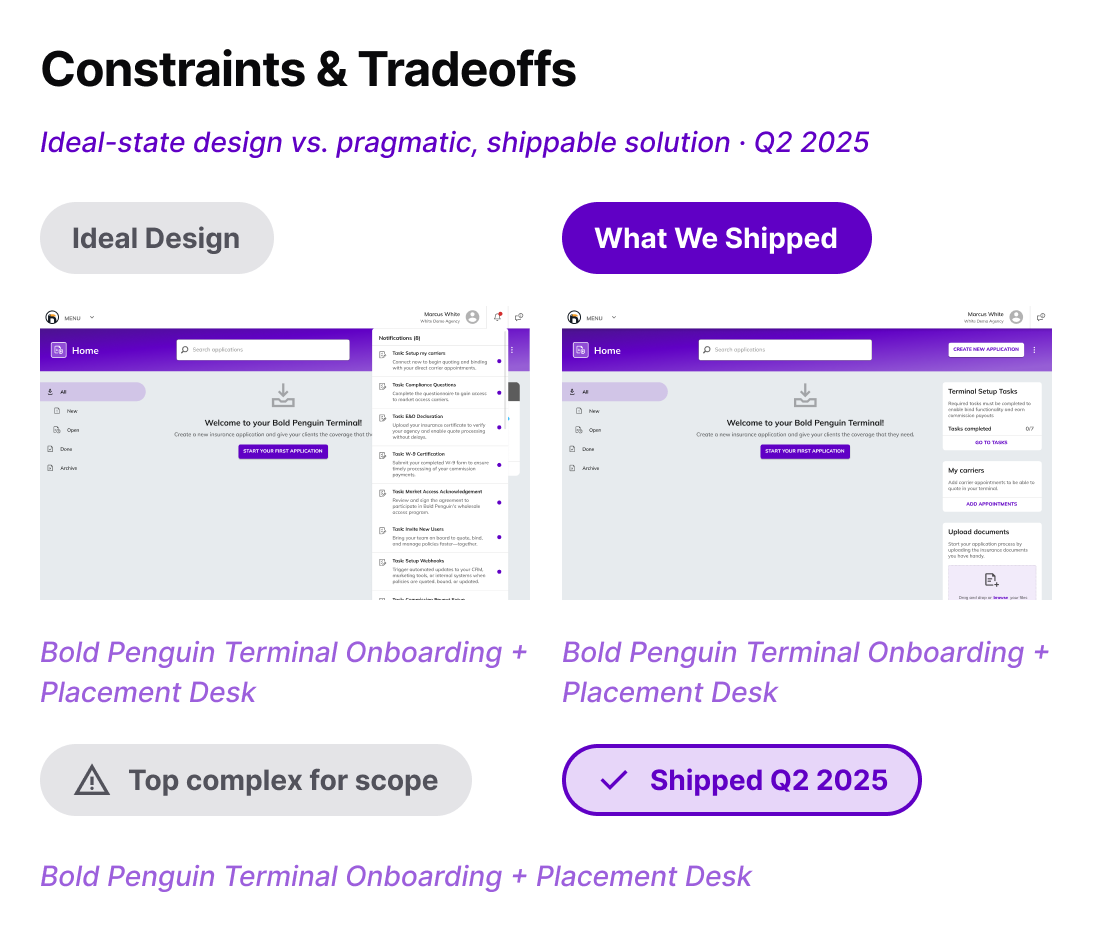
Compromises were made during the project scope around the dashboard notifications menu. Instead, we shipped a dedicated task page within the full onboarding experience after initial sign-up.
Launch Q3 2025 Monthly Bound Premium = $162k. Q4 2025 Monthly Bound Premium = $543k. Has averaged $618k in monthly bound premium in year one.
I led our junior designer in implementing the design mockups, then built a prototype to communicate the intent and outcomes across value, usability, feasibility, and viability to stakeholders.
Evidence of impact
Sign-Up Completion
Time to First Value
Compliance Approval Time
Year 1 Bind Rate
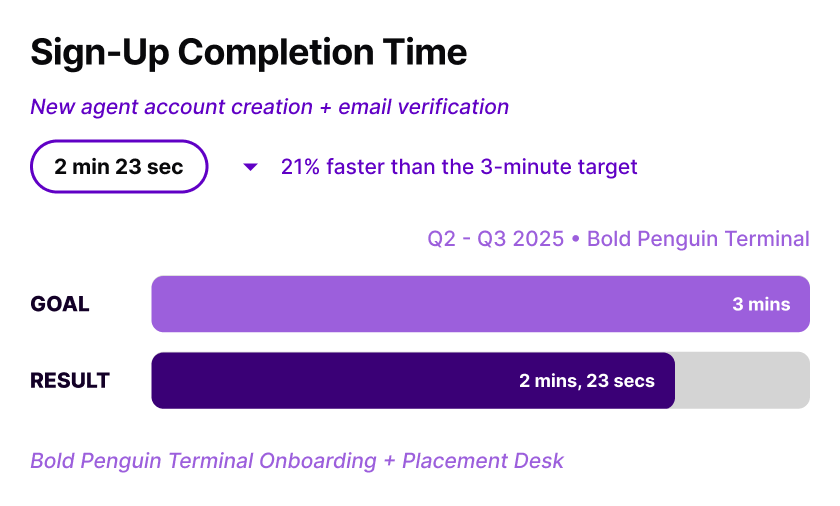
I led research to understand benchmarks for B2B SaaS marketplaces and identify the most meaningful metrics. Based on those findings, I revised our initial sign-up target to three minutes or less and adjusted the first quote submission metric to be within the first 24 hours, setting a more realistic expectation than our previous goals. I then met with stakeholders to review the updated metrics and align on what we would measure at launch.
Constraints and tradeoffs
Under Q2 2025 timeline pressure, the team cut a preferred notifications-menu approach for surfacing setup tasks and shipped a simpler task panel plus dedicated task page, since engineering flagged the notification infrastructure as too complex for the scope, with a V2 plan to revisit. To further reduce product and engineering complexity, the team removed an expedited onboarding path and consolidated into a single guided five-step experience, and also simplified settings navigation by removing tabs to avoid permission-management complexity. Overall, the work reflects intentional tradeoffs from ideal-state design toward a pragmatic, shippable solution while acknowledging discovery risk from primarily internal testing and relying on a clear roadmap to close gaps over time.
Status and next steps
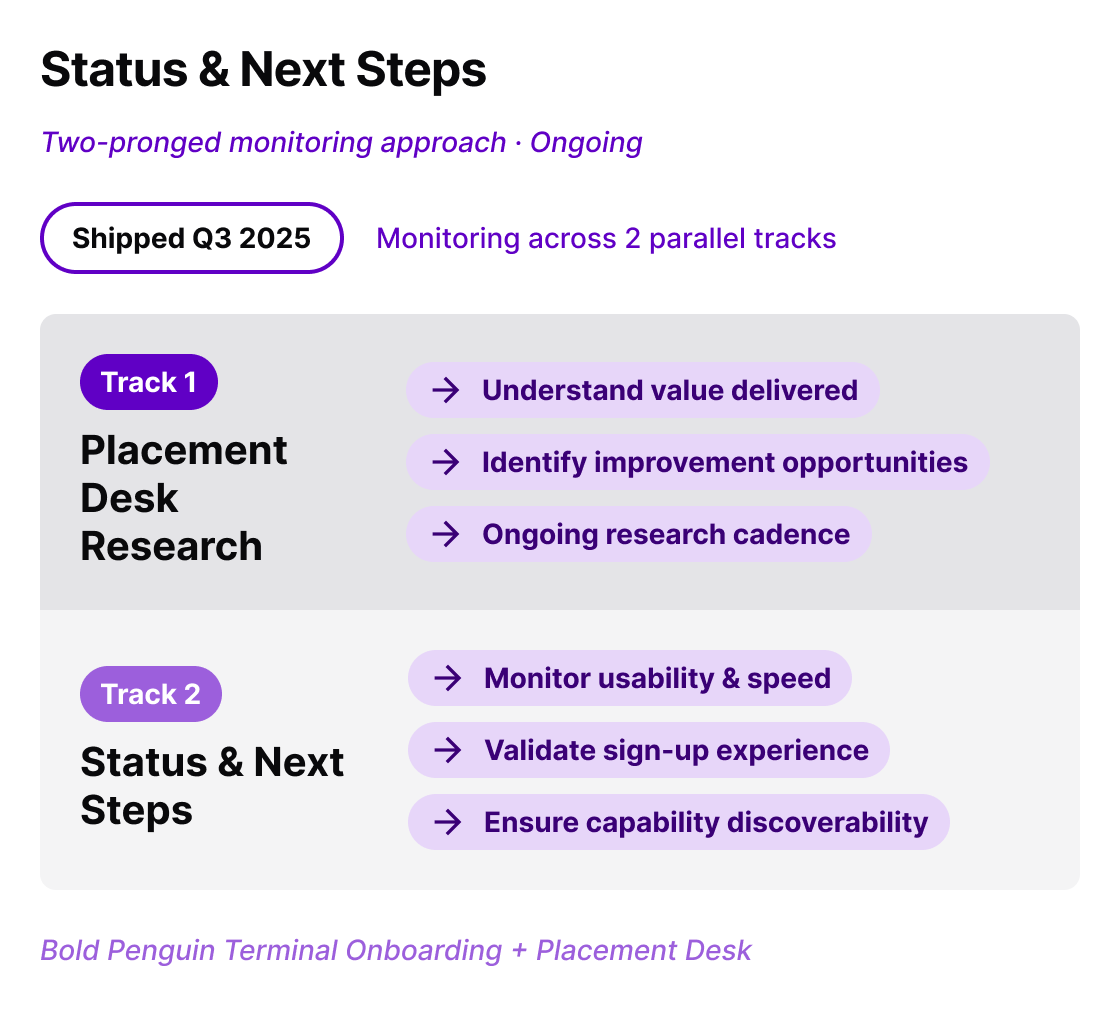
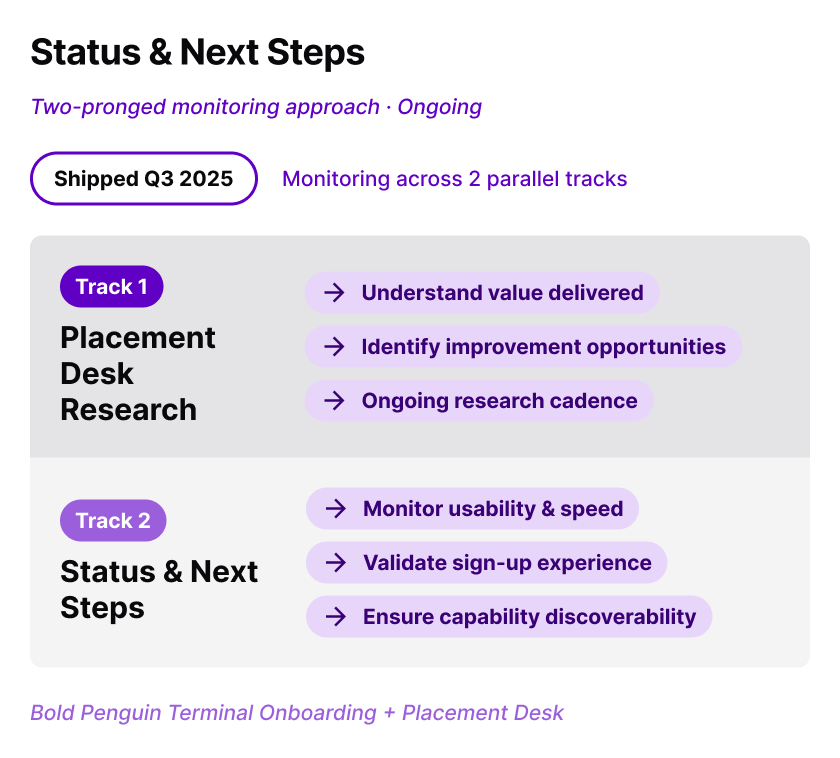
While the success metrics look strong, our goal is to take a two-pronged approach to monitoring this product epic over time. First, we will continue researching and understanding the value delivered through the Placement Desk experience, and how we can improve it over time. Second, we will use research to monitor the onboarding flow to ensure it continues to deliver the value and usability our end users expect, so they can sign up quickly and understand all the capabilities Terminal provides.
How Reducing Onboarding Steps Improved New Agent Conversion in 30 Days
Role: Product Design Manager (design leadership and oversight for the initiative)
Ownership: Led design direction and stakeholder alignment, and supported the end-to-end delivery of the epic
Team: Junior Product Designer (epic owner) and Product Owner (day-to-day product partner), Director of Product (stakeholder), VP of Product (Stakeholder)
Timeline: Q2 2025
Problem & Context
Problem Statement
The Bold Penguin Terminal is a cloud-based commercial insurance platform that lets agents, brokers, and agencies quickly triage risks, then quote, compare, and bind small business policies from multiple carriers through a single, streamlined application interface.
New agents signing up for Bold Penguin’s Terminal often abandon onboarding before completing critical setup steps such as selecting direct or sub-appointments and entering bank account information for commissions. This leads to a surge in support requests to customer success, who must manually complete these steps on behalf of agents, delaying their time to first value—their first successful quote through Terminal—and increasing the operational burden on the CS team.
I scoped and authored the problem statement by synthesizing onboarding drop-off patterns, support signals, and partner input to clearly define the core user + business problem we needed to solve.
Opportunity Solution Tree
New agents signing up for Bold Penguin's Terminal frequently abandoned onboarding before completing critical steps—confused by appointment types, nervous about financial setup, and overwhelmed by a lengthy flow with no clear path to their first quote. To address this, the team introduced Placement Desk, an in-house agency that lets new agents bypass carrier appointments entirely and start quoting immediately. This "fast lane" defers complex setup until after agents experience early value, reducing friction, support load, and time to first quote.
I built the opportunity solution tree to connect the bottleneck to a clear desired outcome, opportunities, and testable assumptions the team could align on.
The Solution Chosen to Pursue
We as a team aligned as a cross-functional team to pursue Placement Desk as the primary lever to reduce early onboarding friction while preserving long-term setup needs.
Success Metrics
- Initial sign-ups (account creation + email verification) should take 60 seconds or less.
- From sign-up to first quote submission should take 5 minutes or less.
- Compliance approval for commission eligibility should take 1 hour or less from when the agent starts compliance tasks.
We defined success metrics together to measure whether the onboarding changes improved time to value and reduced operational load.
Core solution
The original onboarding flow had 12 steps split into two parts: account creation and initial setup.
Before solution prototype link
The updated onboarding flow reduces initial setup from 12 steps to 5 core steps. Once users reach the Terminal dashboard, they can choose an "adventure" path to configure Terminal at their own pace.
After solution prototype link
Is it valuable to the customer?
Is it usable for the end-user?
Is it feasible to for engineering to build?
Is it viable for the business?
13% reduction in support tickets since the launch of the new onboarding within the first 90 days
In five usability sessions, test users completed sign-up on time and understood the onboarding tasks, with the main iteration need being clearer navigation to find tasks and return home.
Compromises were made during the project scope around the dashboard notifications menu. Instead, we shipped a dedicated task page within the full onboarding experience after initial sign-up.
Launch Q3 2025 Monthly Bound Premium = $162k. Q4 2025 Monthly Bound Premium = $543k. Has averaged $618k in monthly bound premium in year one.
I led our junior designer in implementing the design mockups, then built a prototype to communicate the intent and outcomes across value, usability, feasibility, and viability to stakeholders.
Evidence of impact
Sign-Up Completion
Time to First Value
Compliance Approval Time
Year 1 Bind Rate
New agents averaged 2 minutes and 23 seconds to complete initial sign-up — beating the 3-minute goal and delivering a roughly 21% faster signup experience than the previous baseline.
I led research to understand benchmarks for B2B SaaS marketplaces and identify the most meaningful metrics. Based on those findings, I revised our initial sign-up target to three minutes or less and adjusted the first quote submission metric to be within the first 24 hours, setting a more realistic expectation than our previous goals. I then met with stakeholders to review the updated metrics and align on what we would measure at launch.
Constraints and tradeoffs
Under Q2 2025 timeline pressure, the team cut a preferred notifications-menu approach for surfacing setup tasks and shipped a simpler task panel plus dedicated task page, since engineering flagged the notification infrastructure as too complex for the scope, with a V2 plan to revisit. To further reduce product and engineering complexity, the team removed an expedited onboarding path and consolidated into a single guided five-step experience, and also simplified settings navigation by removing tabs to avoid permission-management complexity. Overall, the work reflects intentional tradeoffs from ideal-state design toward a pragmatic, shippable solution while acknowledging discovery risk from primarily internal testing and relying on a clear roadmap to close gaps over time.
Status and next steps
While the success metrics look strong, our goal is to take a two-pronged approach to monitoring this product epic over time. First, we will continue researching and understanding the value delivered through the Placement Desk experience, and how we can improve it over time. Second, we will use research to monitor the onboarding flow to ensure it continues to deliver the value and usability our end users expect, so they can sign up quickly and understand all the capabilities Terminal provides.

Go Back
Final Result Preview
How Reducing Onboarding Steps Improved New Agent Conversion in 30 Days
Role: Product Design Manager (design leadership and oversight for the initiative)
Ownership: Led design direction and stakeholder alignment, and supported the end-to-end delivery of the epic
Team: Junior Product Designer (epic owner) and Product Owner (day-to-day product partner), Director of Product (stakeholder), VP of Product (Stakeholder)
Timeline: Q2 2025
Problem & Context
Problem Statement
The Bold Penguin Terminal is a cloud-based commercial insurance platform that lets agents, brokers, and agencies quickly triage risks, then quote, compare, and bind small business policies from multiple carriers through a single, streamlined application interface.
New agents signing up for Bold Penguin’s Terminal often abandon onboarding before completing critical setup steps such as selecting direct or sub-appointments and entering bank account information for commissions. This leads to a surge in support requests to customer success, who must manually complete these steps on behalf of agents, delaying their time to first value—their first successful quote through Terminal—and increasing the operational burden on the CS team.
I scoped and authored the problem statement by synthesizing onboarding drop-off patterns, support signals, and partner input to clearly define the core user + business problem we needed to solve.
Opportunity Solution Tree
New agents signing up for Bold Penguin's Terminal frequently abandoned onboarding before completing critical steps—confused by appointment types, nervous about financial setup, and overwhelmed by a lengthy flow with no clear path to their first quote. To address this, the team introduced Placement Desk, an in-house agency that lets new agents bypass carrier appointments entirely and start quoting immediately. This "fast lane" defers complex setup until after agents experience early value, reducing friction, support load, and time to first quote.
I built the opportunity solution tree to connect the bottleneck to a clear desired outcome, opportunities, and testable assumptions the team could align on.
The Solution Chosen to Pursue
We as a team aligned as a cross-functional team to pursue Placement Desk as the primary lever to reduce early onboarding friction while preserving long-term setup needs.
Success Metrics
- Initial sign-ups (account creation + email verification) should take 60 seconds or less.
- From sign-up to first quote submission should take 5 minutes or less.
- Compliance approval for commission eligibility should take 1 hour or less from when the agent starts compliance tasks.
We defined success metrics together to measure whether the onboarding changes improved time to value and reduced operational load.
Core solution
The original onboarding flow had 12 steps split into two parts: account creation and initial setup.
Before solution prototype link
The updated onboarding flow reduces initial setup from 12 steps to 5 core steps. Once users reach the Terminal dashboard, they can choose an "adventure" path to configure Terminal at their own pace.
After solution prototype link
Is it valuable to the customer?
Is it usable for the end-user?
Is it feasible to for engineering to build?
Is it viable for the business?
13% reduction in support tickets since the launch of the new onboarding within the first 90 days
In five usability sessions, test users completed sign-up on time and understood the onboarding tasks, with the main iteration need being clearer navigation to find tasks and return home.
Compromises were made during the project scope around the dashboard notifications menu. Instead, we shipped a dedicated task page within the full onboarding experience after initial sign-up.
Launch Q3 2025 Monthly Bound Premium = $162k. Q4 2025 Monthly Bound Premium = $543k. Has averaged $618k in monthly bound premium in year one.
I led our junior designer in implementing the design mockups, then built a prototype to communicate the intent and outcomes across value, usability, feasibility, and viability to stakeholders.
Evidence of impact
New agents averaged 2 minutes and 23 seconds to complete initial sign-up — beating the 3-minute goal and delivering a roughly 21% faster signup experience than the previous baseline.
I led research to understand benchmarks for B2B SaaS marketplaces and identify the most meaningful metrics. Based on those findings, I revised our initial sign-up target to three minutes or less and adjusted the first quote submission metric to be within the first 24 hours, setting a more realistic expectation than our previous goals. I then met with stakeholders to review the updated metrics and align on what we would measure at launch.
Constraints and tradeoffs
Under Q2 2025 timeline pressure, the team cut a preferred notifications-menu approach for surfacing setup tasks and shipped a simpler task panel plus dedicated task page, since engineering flagged the notification infrastructure as too complex for the scope, with a V2 plan to revisit. To further reduce product and engineering complexity, the team removed an expedited onboarding path and consolidated into a single guided five-step experience, and also simplified settings navigation by removing tabs to avoid permission-management complexity. Overall, the work reflects intentional tradeoffs from ideal-state design toward a pragmatic, shippable solution while acknowledging discovery risk from primarily internal testing and relying on a clear roadmap to close gaps over time.
Status and next steps
While the success metrics look strong, our goal is to take a two-pronged approach to monitoring this product epic over time. First, we will continue researching and understanding the value delivered through the Placement Desk experience, and how we can improve it over time. Second, we will use research to monitor the onboarding flow to ensure it continues to deliver the value and usability our end users expect, so they can sign up quickly and understand all the capabilities Terminal provides.
Wrap up here
Back to the homepage for more context and work.
Go Back Home