
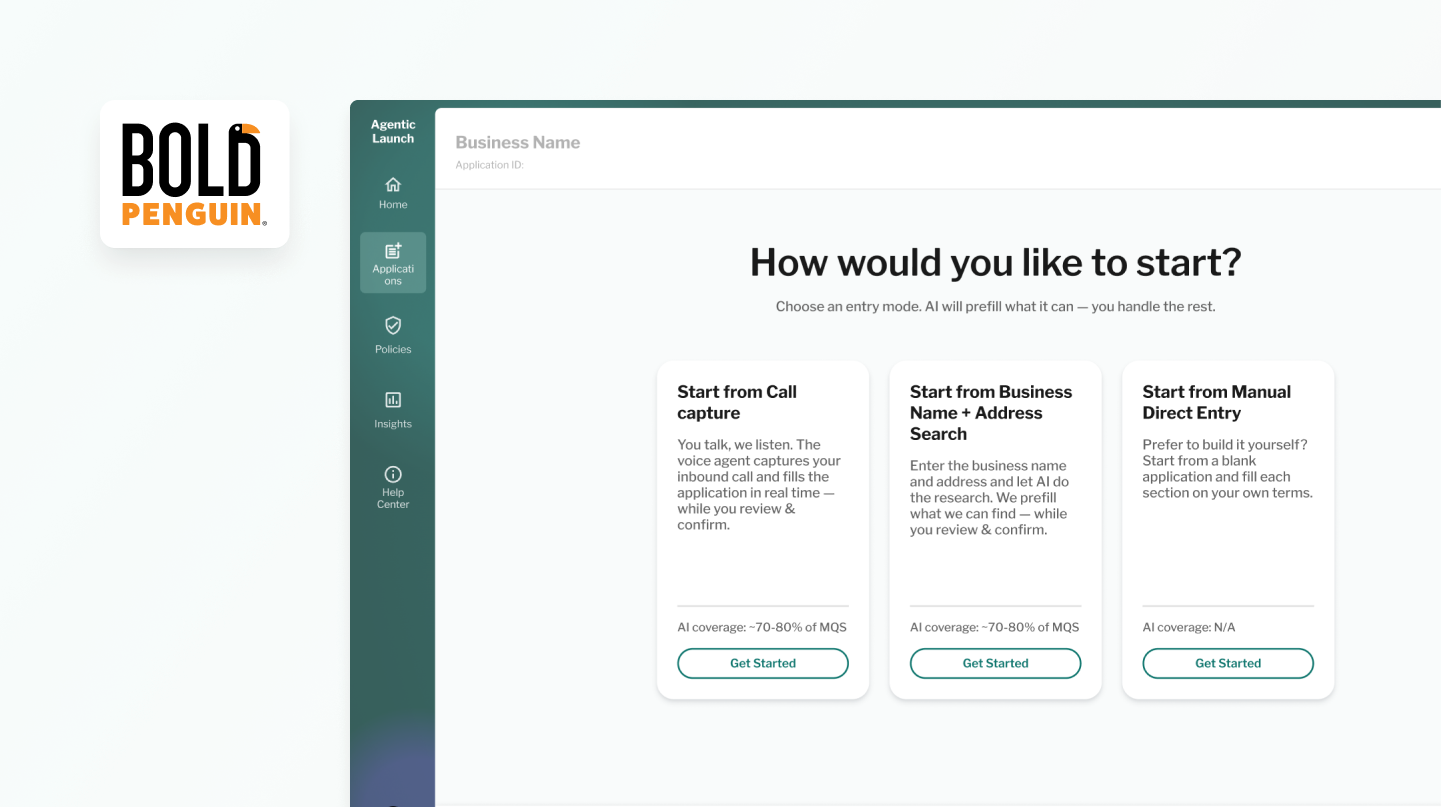
Building an AI Submission Co-Pilot That Earns Agents’ Confidence at Every Step
Role: Product Designer Manager (UI design, UX research, & product outcome delivery)
Ownership: Led product discovery user research UX design, information architecture, prototype testing coordination, design decisions across the co-pilot workflow
Team: Senior Product Manager (day-to-day product partner), VP of Product (stakeholder), VP of Product (Stakeholder)
Timeline: Q2 2026
Problem & Context
Problem Statement
Bold Penguin’s flagship product, the Terminal connects insurance agents, carriers, and underwriters to streamline commercial submissions and uses the resulting binding data to power its platform and reduce friction from quote to bind.
We have heard from both independent and enterprise agents that manually completing submissions for each application for their clients is one of the most time-consuming and tedious parts of their work. We believe we can add significant value by using AI to automate this process. This is an opportunity to streamline the commercial insurance process for everyone involved, including carriers, underwriters, and brokers.
I drove product discovery by conducting user research interviews, mapping agent workflows, and identifying the core breakdown points in the submission lifecycle — then facilitated alignment sessions with the product team to connect those findings to a shared problem statement and build consensus around the solution worth pursuing.
Opportunity Solution Tree
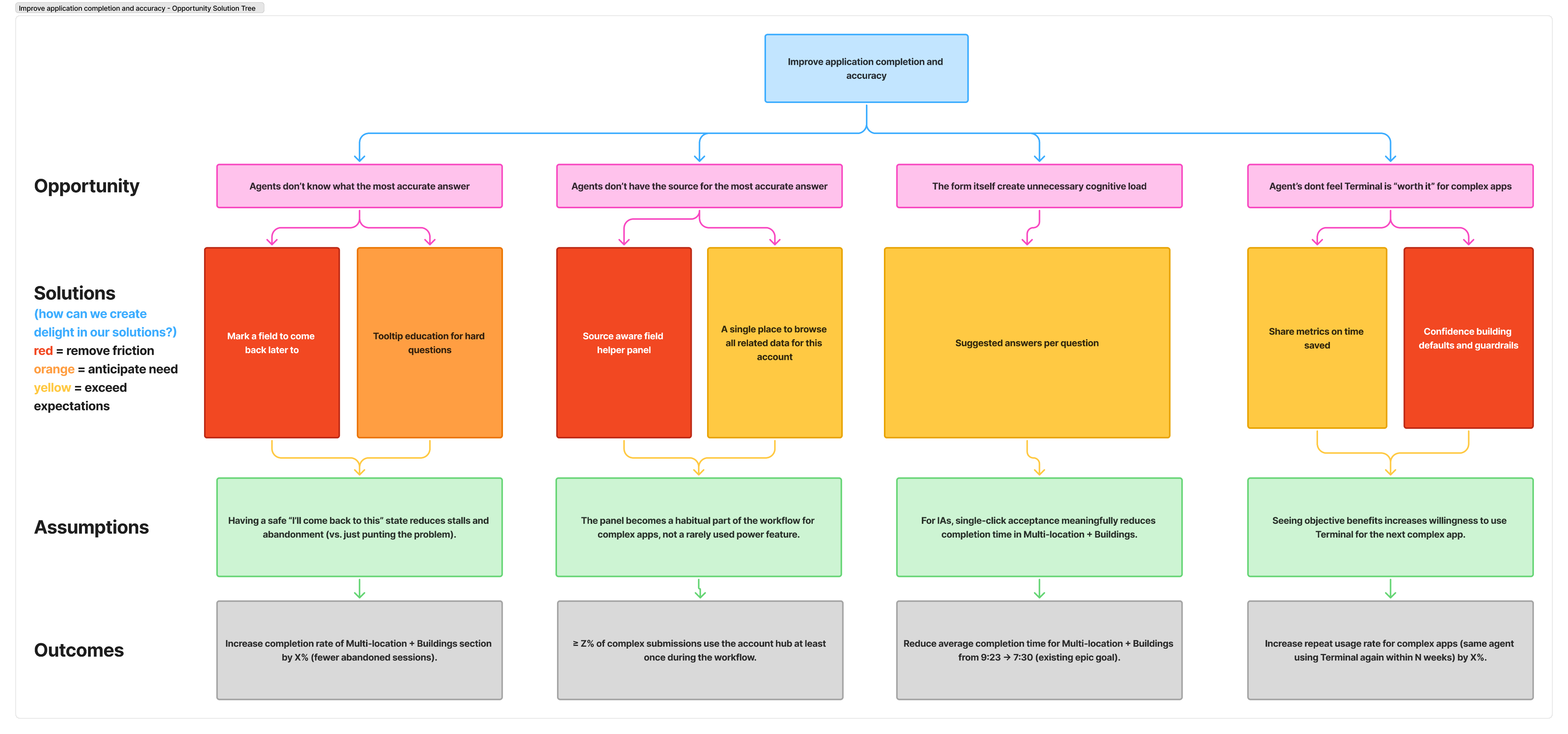
To keep independent agents working entirely within Terminal — from intake to bind — we mapped five opportunities to reduce friction across the submission lifecycle, including reducing data re-entry, increasing bind confidence, and easing renewals. After evaluating the space, we chose to build a new AI-powered universal submission platform that reduces manual entry and proactively surfaces market appetite. Key assumptions we're testing include whether agents will trust AI-generated Market Intelligence output, whether AI can accurately prefill ≥50% of application fields, and whether the bind requirements checklist, proposal link engagement, and renewal agent signals will hold up in real workflows.
I led the opportunity solution tree to align the team around the solution to build a new AI-powered universal submission platform that reduces manual entry and proactively checks the market for appetite.
The Solution Chosen to Pursue
We as team chose to pursue building a new AI-powered universal submission platform that reduces manual entry and proactively surfaces market appetite.
Success Metrics
- Task completion time: Reduce median submission time from 4.25 min to ≤2 min for simple risks and ≤3.5 min for complex risks.
- Pre-quote funnel drop-off: Bring abandonment before quote results down from 84.7% to ≤65% — a ~20-point reduction driven by surfacing appetite earlier.
- Quote-to-bind conversion: Reduce the rate of agents binding on carrier portals from 97.4% to ≤80%, capturing at least 1 in 5 binds currently escaping Terminal.
- In-platform bind rate: Grow in-platform binding from 0.54% to ≥5% — a ~10x lift that serves as the proof-of-concept signal for platform-wide rollout.
These metrics are based on our understanding of our target persona: Adelie risk advisor agents. Through research and persona development, I learned that their three biggest usability issues in Terminal relate to pre-quote drop-off and quote-to-bind conversion, specifically when agents choose to bind in the carrier portal instead of Terminal, which is our preferred outcome. I aligned the team around these success metrics to measure meaningful improvements against those gaps.
Core solution
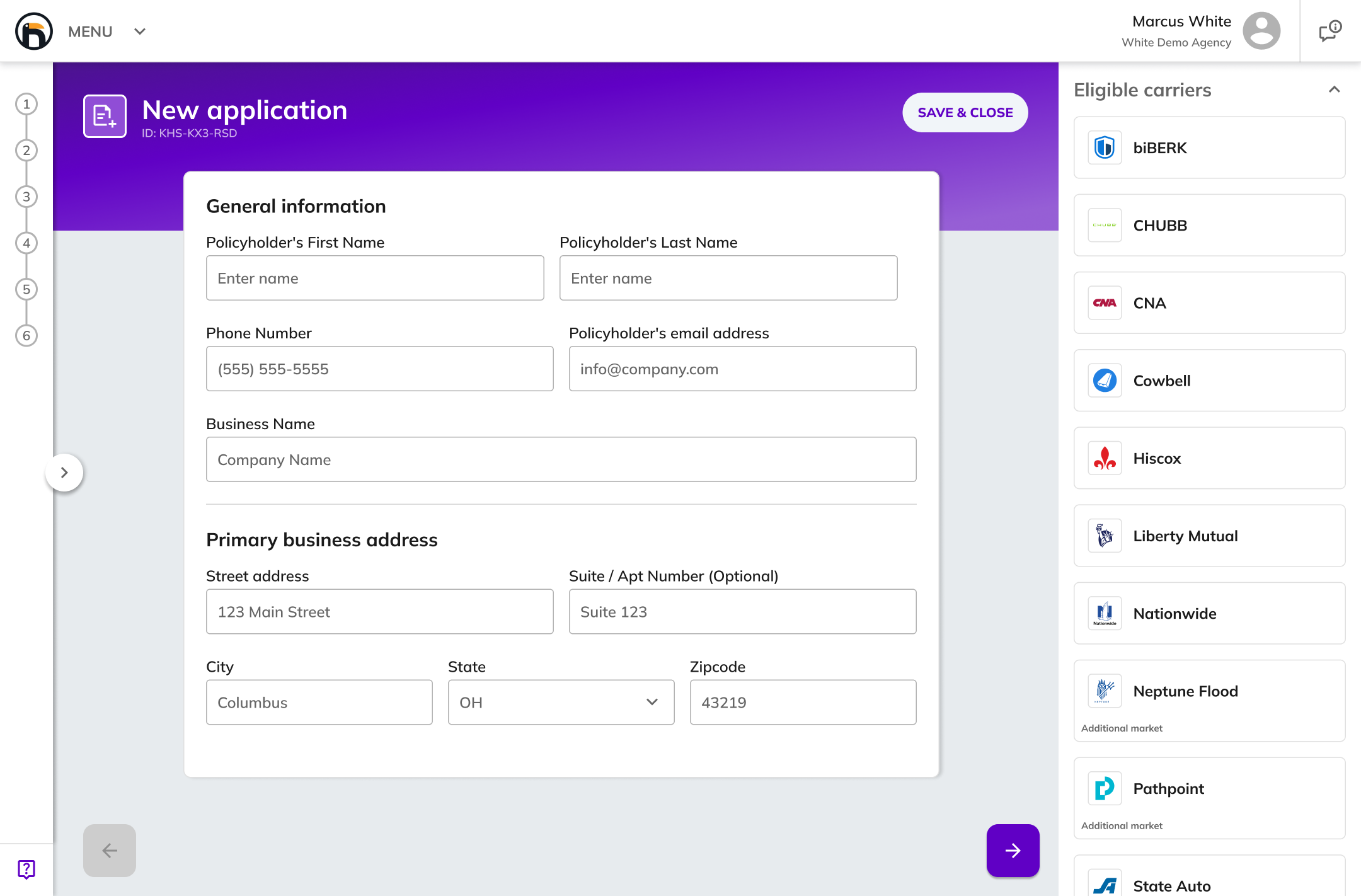
Enter caption
Before solution View
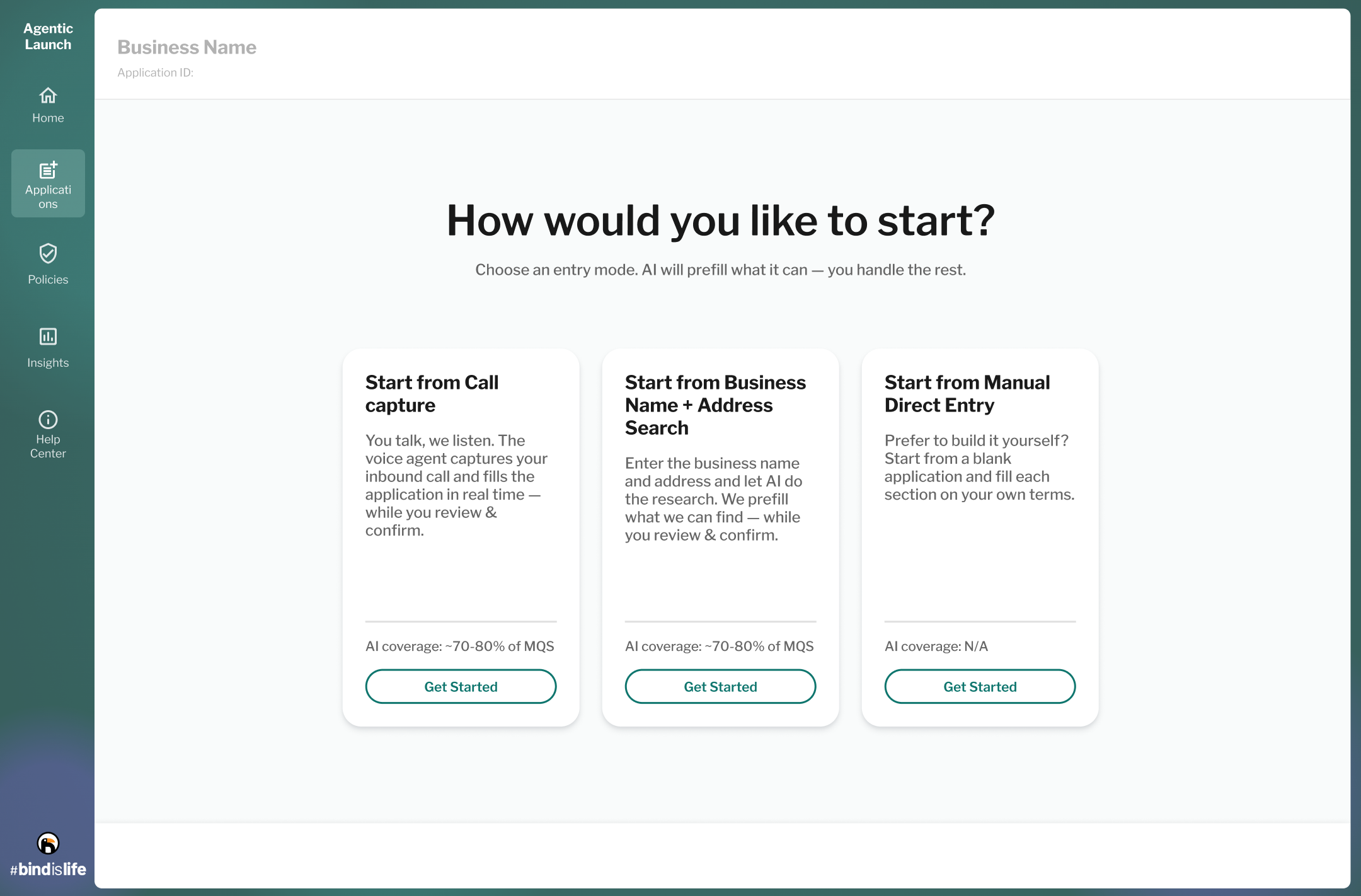
As the final solution, we shipped a platform experience that guides agents through the full submission process with AI and human review working together. During Smart Review, the AI uses five core agents to complete 80% of the work in the background, while the broker completes three high-value steps to review the output. Brokers see which carriers are in play based on market intelligence, select the best-fit quote, share options with the client, and then move into bind and finalization.
Is it valuable to the customer?
Is it usable for the end-user?
Is it feasible to for engineering to build?
Is it viable for the business?
✓ Confirmed. Agents confirmed value in feedback sessions. Fast appetite surfacing and quote customization address real, named pain points — not assumed ones.
In progress. Iterative usability testing with Adelie agents has driven steady design improvements — with one to two final sessions planned next week to validate MVP features before ship.
✓ Confirmed (in progress). Engineering confirmed this will be built within Terminal's existing tech stack — a working demo exists, and the team is now focused on integrating it into the flagship product.
✓ Confirmed. Business case is clear. Improving eligibility abandon from 46.8% → 25% and bind conversion from 0.54% → 2% directly advances BP's distribution strategy.
A separate design and engineering team led the initial Agentic Launch effort, building an AI-powered chat interface for submitting commercial insurance applications. This version was created for demos and customer presentations as a proof of concept.
In my role, I led the design for the Adelie use case version of Agentic Launch, which is intended as a real-world workflow for commercial insurance agents submitting applications while on the phone and working at a computer for a set of clients. This work included low-fidelity mockups, high-fidelity mockups, live prototypes, copywriting, and go-to-market strategy.
Evidence of impact
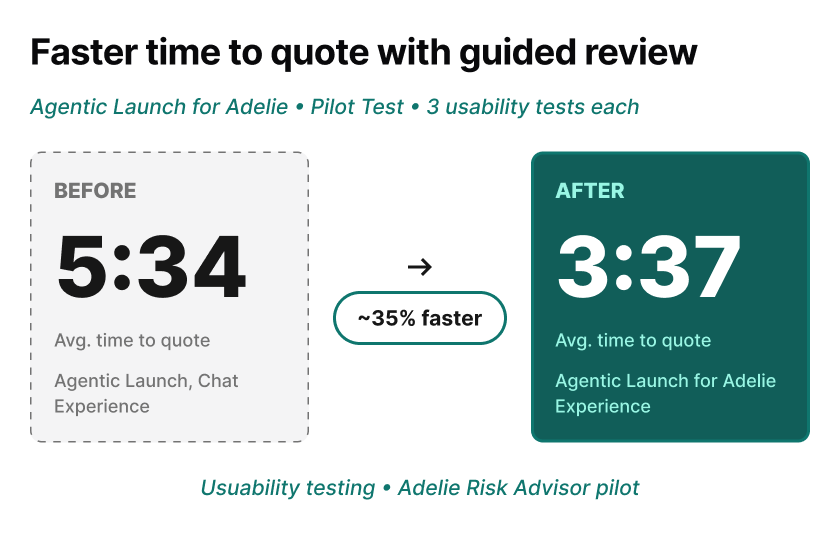
Across three usability tests of Agentic Launch for Adelie, we measured average task completion time for an application submission. For simple risks, it took about 5 minutes and 34 seconds to receive a quote. This was largely because users were unsure what to do next after each prompt result, which caused stalling in the chat experience.
We ran three additional usability tests for the Agentic Launch for Adelie experience. On average, agents were able to go from intake to quote selection in about 3 minutes and 37 seconds, enabled by the improved usability of a guided review-and-approve experience.
Constraints and tradeoffs
Leadership direction vs. end-user usability
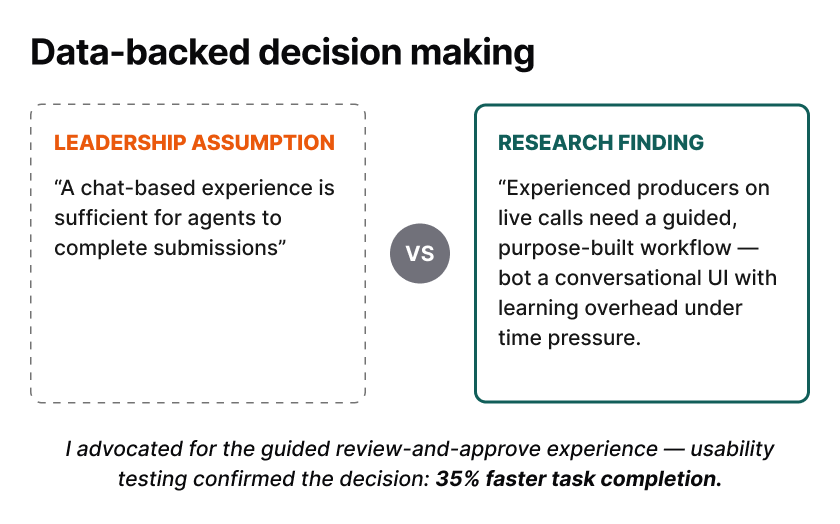
Leadership prioritized speed to market and began the project with a strong assumption: that a chat-based experience would be sufficient for agents to do their jobs. Value and viability were largely validated, but usability — whether agents could actually complete their work without added friction — remained the critical open question. I advocated against shipping the chat experience as the primary interface, arguing that experienced commercial insurance producers handling live inbound calls needed a purpose-built, guided workflow, not a conversational UI that added learning overhead under time pressure. Redirecting the team required pushing back on leadership assumptions and recentering the product on agents’ real working conditions.
Token cost per submission
Before committing to a multi-agent agentic architecture, we needed to understand whether this product could be profitable at scale. Through analysis of the full agent orchestration model (8 sub-agents across 6 workflow stages), we determined that a full end-to-end submission costs approximately $0.57 per submission in LLM API spend — with Stage 2 (Parallel Co-Pilot) accounting for the largest share at ~$0.23. This analysis gave the team a clear cost foundation to evaluate scalability: at 10,000 submissions/month, direct model costs remain under $6K/month, making the architecture viable if adoption targets are met. Token cost modeling became a prerequisite for engineering commitment, not an afterthought.
Status and next steps
Task completion time is trending in the right direction and is nearing a shippable threshold for the Adelie pilot. Once shipped, we will monitor performance over the quarter against our four core success metrics: pre-quote funnel drop-off rate, quote-to-bind conversion rate, and in-platform bind rate. These indicators will show how well the product performs for independent agents in a live production environment.
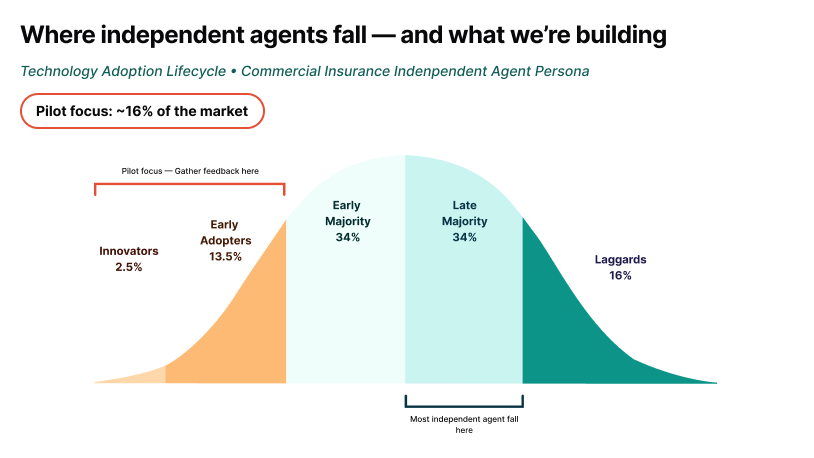
Adelie Risk Advisors was chosen deliberately as the pilot partner. As an in-house independent agency, they represent the independent commercial agent persona at full fidelity. The pain points, behaviors, and goals that define the Adelie agent overlap significantly with those of our broader agent population, including enterprise agents. Getting this right for Adelie means getting it right for the independent commercial agent more broadly, and the lessons will carry forward as we scale to a wider market.
The goal from here is to nail the pilot: ship a product that works well for Adelie over time, measure outcomes against our targets, and iterate as we expand to a broader user base.
Wrap up here
Back to the homepage for more context and work.
Go Back Home

Marcus White

Resume

Building an AI Submission Co-Pilot That Earns Agents’ Confidence at Every Step
Role: Product Designer Manager (UI design, UX research, & product outcome delivery)
Ownership: Led product discovery user research UX design, information architecture, prototype testing coordination, design decisions across the co-pilot workflow
Team: Senior Product Manager (day-to-day product partner), VP of Product (stakeholder), VP of Product (Stakeholder)
Timeline: Q2 2026
Problem & Context
Problem Statement
Bold Penguin’s flagship product, the Terminal connects insurance agents, carriers, and underwriters to streamline commercial submissions and uses the resulting binding data to power its platform and reduce friction from quote to bind.
We have heard from both independent and enterprise agents that manually completing submissions for each application for their clients is one of the most time-consuming and tedious parts of their work. We believe we can add significant value by using AI to automate this process. This is an opportunity to streamline the commercial insurance process for everyone involved, including carriers, underwriters, and brokers.
I drove product discovery by conducting user research interviews, mapping agent workflows, and identifying the core breakdown points in the submission lifecycle — then facilitated alignment sessions with the product team to connect those findings to a shared problem statement and build consensus around the solution worth pursuing.
Opportunity Solution Tree
To keep independent agents working entirely within Terminal — from intake to bind — we mapped five opportunities to reduce friction across the submission lifecycle, including reducing data re-entry, increasing bind confidence, and easing renewals. After evaluating the space, we chose to build a new AI-powered universal submission platform that reduces manual entry and proactively surfaces market appetite. Key assumptions we're testing include whether agents will trust AI-generated Market Intelligence output, whether AI can accurately prefill ≥50% of application fields, and whether the bind requirements checklist, proposal link engagement, and renewal agent signals will hold up in real workflows.
I led the opportunity solution tree to align the team around the solution to build a new AI-powered universal submission platform that reduces manual entry and proactively checks the market for appetite.
The Solution Chosen to Pursue
We as team chose to pursue building a new AI-powered universal submission platform that reduces manual entry and proactively surfaces market appetite.
Success Metrics
- Task completion time: Reduce median submission time from 4.25 min to ≤2 min for simple risks and ≤3.5 min for complex risks.
- Pre-quote funnel drop-off: Bring abandonment before quote results down from 84.7% to ≤65% — a ~20-point reduction driven by surfacing appetite earlier.
- Quote-to-bind conversion: Reduce the rate of agents binding on carrier portals from 97.4% to ≤80%, capturing at least 1 in 5 binds currently escaping Terminal.
- In-platform bind rate: Grow in-platform binding from 0.54% to ≥5% — a ~10x lift that serves as the proof-of-concept signal for platform-wide rollout.
These metrics are based on our understanding of our target persona: Adelie risk advisor agents. Through research and persona development, I learned that their three biggest usability issues in Terminal relate to pre-quote drop-off and quote-to-bind conversion, specifically when agents choose to bind in the carrier portal instead of Terminal, which is our preferred outcome. I aligned the team around these success metrics to measure meaningful improvements against those gaps.
Core solution
Enter caption
Before solution View
As the final solution, we shipped a platform experience that guides agents through the full submission process with AI and human review working together. During Smart Review, the AI uses five core agents to complete 80% of the work in the background, while the broker completes three high-value steps to review the output. Brokers see which carriers are in play based on market intelligence, select the best-fit quote, share options with the client, and then move into bind and finalization.
Is it valuable to the customer?
Is it usable for the end-user?
Is it feasible to for engineering to build?
Is it viable for the business?
✓ Confirmed. Agents confirmed value in feedback sessions. Fast appetite surfacing and quote customization address real, named pain points — not assumed ones.
In progress. Iterative usability testing with Adelie agents has driven steady design improvements — with one to two final sessions planned next week to validate MVP features before ship.
✓ Confirmed (in progress). Engineering confirmed this will be built within Terminal's existing tech stack — a working demo exists, and the team is now focused on integrating it into the flagship product.
✓ Confirmed. Business case is clear. Improving eligibility abandon from 46.8% → 25% and bind conversion from 0.54% → 2% directly advances BP's distribution strategy.
A separate design and engineering team led the initial Agentic Launch effort, building an AI-powered chat interface for submitting commercial insurance applications. This version was created for demos and customer presentations as a proof of concept.
In my role, I led the design for the Adelie use case version of Agentic Launch, which is intended as a real-world workflow for commercial insurance agents submitting applications while on the phone and working at a computer for a set of clients. This work included low-fidelity mockups, high-fidelity mockups, live prototypes, copywriting, and go-to-market strategy.
Evidence of impact
Across three usability tests of Agentic Launch for Adelie, we measured average task completion time for an application submission. For simple risks, it took about 5 minutes and 34 seconds to receive a quote. This was largely because users were unsure what to do next after each prompt result, which caused stalling in the chat experience.
We ran three additional usability tests for the Agentic Launch for Adelie experience. On average, agents were able to go from intake to quote selection in about 3 minutes and 37 seconds, enabled by the improved usability of a guided review-and-approve experience.
Constraints and tradeoffs
Leadership direction vs. end-user usability
Leadership prioritized speed to market and began the project with a strong assumption: that a chat-based experience would be sufficient for agents to do their jobs. Value and viability were largely validated, but usability — whether agents could actually complete their work without added friction — remained the critical open question. I advocated against shipping the chat experience as the primary interface, arguing that experienced commercial insurance producers handling live inbound calls needed a purpose-built, guided workflow, not a conversational UI that added learning overhead under time pressure. Redirecting the team required pushing back on leadership assumptions and recentering the product on agents’ real working conditions.
Token cost per submission
Before committing to a multi-agent agentic architecture, we needed to understand whether this product could be profitable at scale. Through analysis of the full agent orchestration model (8 sub-agents across 6 workflow stages), we determined that a full end-to-end submission costs approximately $0.57 per submission in LLM API spend — with Stage 2 (Parallel Co-Pilot) accounting for the largest share at ~$0.23. This analysis gave the team a clear cost foundation to evaluate scalability: at 10,000 submissions/month, direct model costs remain under $6K/month, making the architecture viable if adoption targets are met. Token cost modeling became a prerequisite for engineering commitment, not an afterthought.
Status and next steps
Task completion time is trending in the right direction and is nearing a shippable threshold for the Adelie pilot. Once shipped, we will monitor performance over the quarter against our four core success metrics: pre-quote funnel drop-off rate, quote-to-bind conversion rate, and in-platform bind rate. These indicators will show how well the product performs for independent agents in a live production environment.
Adelie Risk Advisors was chosen deliberately as the pilot partner. As an in-house independent agency, they represent the independent commercial agent persona at full fidelity. The pain points, behaviors, and goals that define the Adelie agent overlap significantly with those of our broader agent population, including enterprise agents. Getting this right for Adelie means getting it right for the independent commercial agent more broadly, and the lessons will carry forward as we scale to a wider market.
The goal from here is to nail the pilot: ship a product that works well for Adelie over time, measure outcomes against our targets, and iterate as we expand to a broader user base.
Wrap up here
Back to the homepage for more context and work.
Go Back Home
Marcus White
Resume
Building an AI Submission Co-Pilot That Earns Agents’ Confidence at Every Step
Role: Product Designer Manager (UI design, UX research, & product outcome delivery)
Ownership: Led product discovery user research UX design, information architecture, prototype testing coordination, design decisions across the co-pilot workflow
Team: Senior Product Manager (day-to-day product partner), VP of Product (stakeholder), VP of Product (Stakeholder)
Timeline: Q2 2026
Problem & Context
Problem Statement
Bold Penguin’s flagship product, the Terminal connects insurance agents, carriers, and underwriters to streamline commercial submissions and uses the resulting binding data to power its platform and reduce friction from quote to bind.
We have heard from both independent and enterprise agents that manually completing submissions for each application for their clients is one of the most time-consuming and tedious parts of their work. We believe we can add significant value by using AI to automate this process. This is an opportunity to streamline the commercial insurance process for everyone involved, including carriers, underwriters, and brokers.
I drove product discovery by conducting user research interviews, mapping agent workflows, and identifying the core breakdown points in the submission lifecycle — then facilitated alignment sessions with the product team to connect those findings to a shared problem statement and build consensus around the solution worth pursuing.
Opportunity Solution Tree
To keep independent agents working entirely within Terminal — from intake to bind — we mapped five opportunities to reduce friction across the submission lifecycle, including reducing data re-entry, increasing bind confidence, and easing renewals. After evaluating the space, we chose to build a new AI-powered universal submission platform that reduces manual entry and proactively surfaces market appetite. Key assumptions we're testing include whether agents will trust AI-generated Market Intelligence output, whether AI can accurately prefill ≥50% of application fields, and whether the bind requirements checklist, proposal link engagement, and renewal agent signals will hold up in real workflows.
I led the opportunity solution tree to align the team around the solution to build a new AI-powered universal submission platform that reduces manual entry and proactively checks the market for appetite.
The Solution Chosen to Pursue
We as team chose to pursue building a new AI-powered universal submission platform that reduces manual entry and proactively surfaces market appetite.
Success Metrics
- Task completion time: Reduce median submission time from 4.25 min to ≤2 min for simple risks and ≤3.5 min for complex risks.
- Pre-quote funnel drop-off: Bring abandonment before quote results down from 84.7% to ≤65% — a ~20-point reduction driven by surfacing appetite earlier.
- Quote-to-bind conversion: Reduce the rate of agents binding on carrier portals from 97.4% to ≤80%, capturing at least 1 in 5 binds currently escaping Terminal.
- In-platform bind rate: Grow in-platform binding from 0.54% to ≥5% — a ~10x lift that serves as the proof-of-concept signal for platform-wide rollout.
These metrics are based on our understanding of our target persona: Adelie risk advisor agents. Through research and persona development, I learned that their three biggest usability issues in Terminal relate to pre-quote drop-off and quote-to-bind conversion, specifically when agents choose to bind in the carrier portal instead of Terminal, which is our preferred outcome. I aligned the team around these success metrics to measure meaningful improvements against those gaps.
Core solution
Enter caption
Before solution View
As the final solution, we shipped a platform experience that guides agents through the full submission process with AI and human review working together. During Smart Review, the AI uses five core agents to complete 80% of the work in the background, while the broker completes three high-value steps to review the output. Brokers see which carriers are in play based on market intelligence, select the best-fit quote, share options with the client, and then move into bind and finalization.
Is it valuable to the customer?
Is it usable for the end-user?
Is it feasible to for engineering to build?
Is it viable for the business?
✓ Confirmed. Agents confirmed value in feedback sessions. Fast appetite surfacing and quote customization address real, named pain points — not assumed ones.
In progress. Iterative usability testing with Adelie agents has driven steady design improvements — with one to two final sessions planned next week to validate MVP features before ship.
✓ Confirmed (in progress). Engineering confirmed this will be built within Terminal's existing tech stack — a working demo exists, and the team is now focused on integrating it into the flagship product.
✓ Confirmed. Business case is clear. Improving eligibility abandon from 46.8% → 25% and bind conversion from 0.54% → 2% directly advances BP's distribution strategy.
A separate design and engineering team led the initial Agentic Launch effort, building an AI-powered chat interface for submitting commercial insurance applications. This version was created for demos and customer presentations as a proof of concept.
In my role, I led the design for the Adelie use case version of Agentic Launch, which is intended as a real-world workflow for commercial insurance agents submitting applications while on the phone and working at a computer for a set of clients. This work included low-fidelity mockups, high-fidelity mockups, live prototypes, copywriting, and go-to-market strategy.
Evidence of impact
Across three usability tests of Agentic Launch for Adelie, we measured average task completion time for an application submission. For simple risks, it took about 5 minutes and 34 seconds to receive a quote. This was largely because users were unsure what to do next after each prompt result, which caused stalling in the chat experience.
We ran three additional usability tests for the Agentic Launch for Adelie experience. On average, agents were able to go from intake to quote selection in about 3 minutes and 37 seconds, enabled by the improved usability of a guided review-and-approve experience.
Constraints and tradeoffs
Leadership direction vs. end-user usability
Leadership prioritized speed to market and began the project with a strong assumption: that a chat-based experience would be sufficient for agents to do their jobs. Value and viability were largely validated, but usability — whether agents could actually complete their work without added friction — remained the critical open question. I advocated against shipping the chat experience as the primary interface, arguing that experienced commercial insurance producers handling live inbound calls needed a purpose-built, guided workflow, not a conversational UI that added learning overhead under time pressure. Redirecting the team required pushing back on leadership assumptions and recentering the product on agents’ real working conditions.
Token cost per submission
Before committing to a multi-agent agentic architecture, we needed to understand whether this product could be profitable at scale. Through analysis of the full agent orchestration model (8 sub-agents across 6 workflow stages), we determined that a full end-to-end submission costs approximately $0.57 per submission in LLM API spend — with Stage 2 (Parallel Co-Pilot) accounting for the largest share at ~$0.23. This analysis gave the team a clear cost foundation to evaluate scalability: at 10,000 submissions/month, direct model costs remain under $6K/month, making the architecture viable if adoption targets are met. Token cost modeling became a prerequisite for engineering commitment, not an afterthought.
Status and next steps
Task completion time is trending in the right direction and is nearing a shippable threshold for the Adelie pilot. Once shipped, we will monitor performance over the quarter against our four core success metrics: pre-quote funnel drop-off rate, quote-to-bind conversion rate, and in-platform bind rate. These indicators will show how well the product performs for independent agents in a live production environment.
Adelie Risk Advisors was chosen deliberately as the pilot partner. As an in-house independent agency, they represent the independent commercial agent persona at full fidelity. The pain points, behaviors, and goals that define the Adelie agent overlap significantly with those of our broader agent population, including enterprise agents. Getting this right for Adelie means getting it right for the independent commercial agent more broadly, and the lessons will carry forward as we scale to a wider market.
The goal from here is to nail the pilot: ship a product that works well for Adelie over time, measure outcomes against our targets, and iterate as we expand to a broader user base.
Wrap up here
Back to the homepage for more context and work.
Go Back Home